Spica75 wrote:Gravity most certainly has little(nothing) to do with "keeping us together". And while humans can´t survive vacuum, there´s nothing at all preventing the existence of something living that can. And a human ending up weightless in vacuum does NOT disintegrate in any way.
There is, in fact, a creature known for surviving in vacuum: the tardigrade, or water bear.
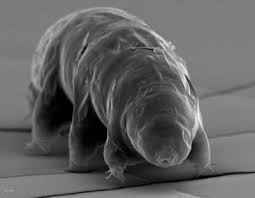
Mind you, they're only a millimeter long.
Gravity has its uses in human survival, no question there. It keeps us from floating into the air, and it keeps the air where we need it. The people on the ISS have no problem surviving for six months or so without gravity -- they have an airtight compartment. (Long-term life in zero g is not good for the health. Short term, no problem.) The electromagnetic force holds our atoms and molecules in place; the strong nuclear force holds the nuclei of our atoms together, and the weak nuclear force only shows up for radioactive decay.
If you suddenly were not affected by gravity, it'd be rather like being a person-shaped helium balloon. You would rise into the air like that balloon, slowly. Eventually, you'd reach the top of the atmosphere. What happens after that depends on whether you've lost inertial mass as well as gravitational mass, but most likely you'd just keep on going at the speed of the earth in its orbit. The earth would circle out from under you, in its trip around the sun.
All you would need to avoid this fate is a pocket full of rocks. But be careful about skinny-dipping. Save nudity for indoors.
 Posted: Tue Aug 20, 2013 9:27 pm